
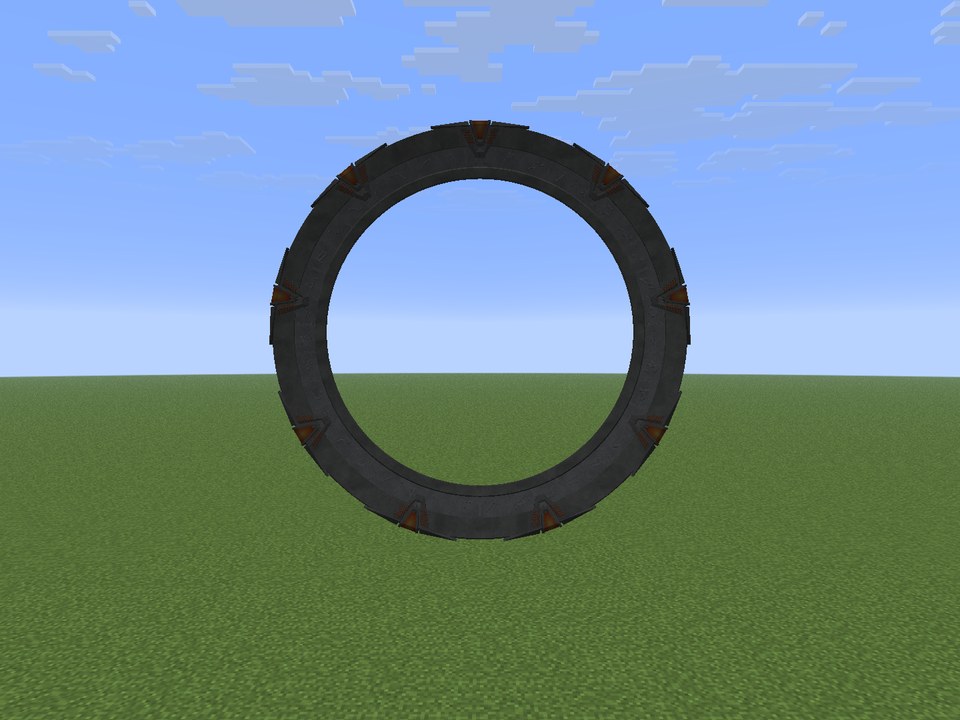
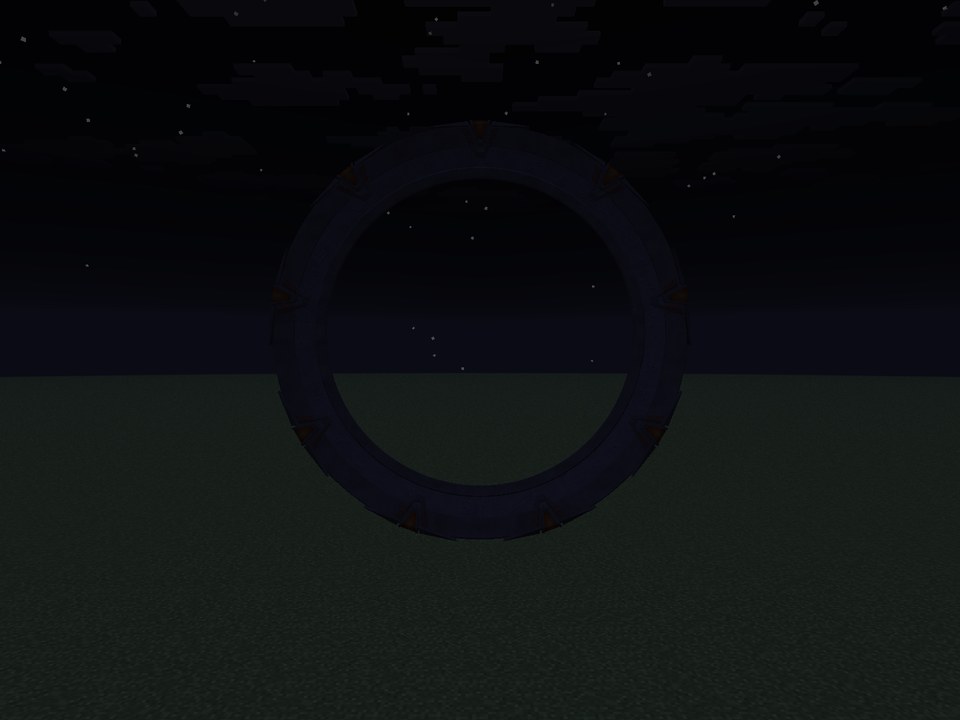
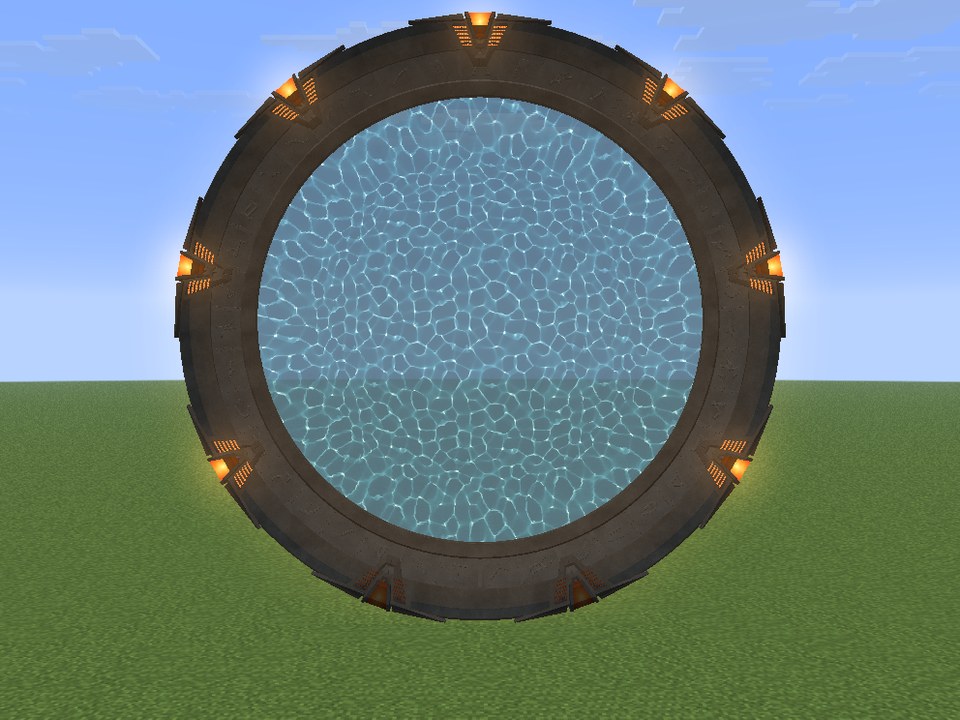
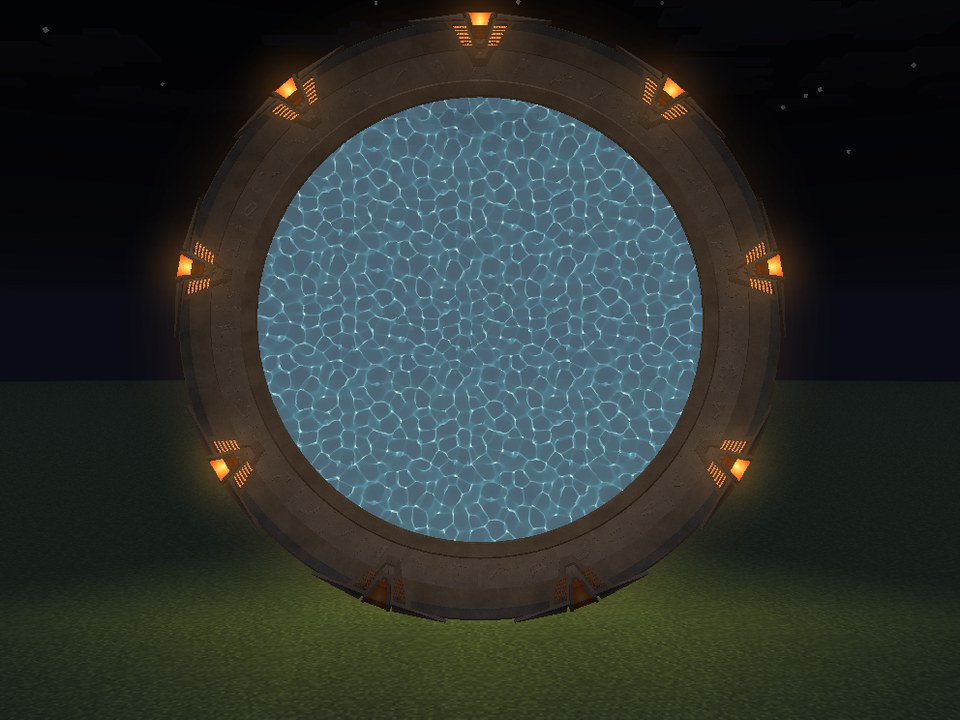
The Supergate Base is the block at the bottom of a supergate's ring. It finds the ring around it, opens the gate's address screen and holds the gate's type, chevrons, camouflage, ZPMs and fitted upgrades.
The finished gate
Obtaining
Crafting
You make it from a  Milky Way Stargate Base.


Usage
A supergate's ring is every block a circle passes through, with the base at the bottom. The 9 blocks nearest the 9 chevron angles are  Supergate Chevron Block and the rest are Supergate Ring Block. See Supergate Ring Block for how many blocks each size takes.
- Place the base where the bottom of the ring goes. It faces you, and the gate faces the same way.
- Build the ring across its front. The space inside doesn't need to be clear: only the ring blocks are checked.
- The gate forms when you place the last block of the ring, or the base next to a complete ring. The base looks for the smallest complete ring of supergate blocks around it, from radius 4 to 30. If there is no standing ring, it looks for one lying flat at its own height, running out from the base along its back.
The player whose block finished the gate owns it. The ring is hard to lay out by hand: an operator can run /sgcraft place sgcraft:milky_way 9 10 to build a supergate of radius 10, or place a supergate spawner. See Building gates for the full build.
Gate type
A supergate forms as a Milky Way gate (sgcraft:milky_way). To change the type of a formed, idle supergate, use a  Pegasus Gate Upgrade or a
 Universe Gate Upgrade on it. You need the right to configure the gate, and the upgrade is used up. Operators and creative players can set the type on the
 Stargate Configurator's Gate page instead, and operators can run
/sgcraft type <type>.
The Ori type
A supergate can also be an Ori supergate (sgcraft:ori), which comes only as a supergate. No upgrade item makes one. Operators and creative players choose Ori as the Type on the configurator's Gate page, which offers it only for supergates, and operators can run /sgcraft type sgcraft:ori. An operator can also place an  Ori Supergate Spawner.
- An Ori supergate connects only to other Ori supergates. A dial between it and a gate of any other type fails with "This gate can't connect to that type of gate".
- No DHD links to it. Dial it with a PDD, a gate control tablet, an
 Explorer Dialer Device,
/sgcraft dialor the API. It always dials symbol by symbol. - It takes no iris, shield or upgrades ("An Ori supergate takes no upgrades"), always reaches as far as 9 chevrons, and its chevrons can't be changed.
- Turning a gate Ori takes its iris or shield off. The upgrade it was fitted with drops at the base, unless the gate came with it.
See Ori supergates for how its ring links as it dials.
A supergate keeps the type it was given while its base stays in place, even if the ring breaks apart and forms again. Breaking the base drops the upgrade that set the type, if one did, and the Supergate Base forms a Milky Way gate again when placed.
A DHD of the gate's type links to a supergate the same way it links to a standard gate: by the distance to the base, less than the gate's dhd_range (default 6). See The DHD.
Supergates and standard gates
A supergate works like a standard gate, with these differences:
- When the wormhole opens, the kawoosh clears at most 4096 blocks in front of the gate.
- A wormhole to or from a supergate costs 8 times as much (
energy.multipliers.supergate, default 8.0). See Power. - Its base has 3 ZPM slots, which add to the energy it can draw on. See ZPMs.
- Between gates of different sizes, travelers come out inside the far opening where they went in, scaled to its size. See Dialing.
- The open event horizon gives light from only some of its blocks, spread across the opening. See Event Horizon.
The address screen
Right-click the base, or any ring block of the formed supergate, to open the Stargate Address screen. The base opens nothing until the gate has formed. Gate tools and upgrades in your hand work on the gate instead of opening the screen.
- The screen shows the gate's address in the glyphs of the gate's type, with the address in letters below.
- Click the panel to copy the address. The client setting
copy_address_on_open(defaultfalse) copies it each time the screen opens. - When the gate's
address_visibleproperty is off, the screen shows "... Gate Address Hidden ...". See Addresses. - A player with the right to configure a standing gate also sees 5 slots labeled Base Camouflage. Each slot takes one block and covers one of the 5 blocks of the bottom row centered on the base, left to right as seen from the front. Any block works except ring blocks, bases and DHDs. A flat gate takes no camouflage. See Building gates.
- The same players see the base's 3 ZPM slots, labeled ZPMs, to the right of the camouflage slots, and the supergate's ZPMs below the screen. See ZPMs.
ZPMs
A supergate needs no ZPMs. It draws on DHD fuel, power units and ZPMs as a standard gate does, the nearest of each first. See Power.
The base has 3 ZPM slots, which take only ZPMs, one to a slot. The ZPMs in them are more energy for the supergate to draw on, and it takes from them before any other ZPM. Open the base's screen with the right to configure the gate to reach them. A flat supergate's base opens too, for its ZPM slots, though it shows no camouflage slots.
After its own slots, the supergate draws on the ZPMs in each  ZPM Console,
 ZPM Interface Cart and
 ZPM Hub within 6 blocks of the base along each axis (
zpm.search_range) or linked to it, nearest first. It takes their gate energy (GE) as it takes any other. A hub that holds more than one ZPM makes them go further.
Below the screen:
| Line | What it shows |
|---|---|
| ZPMs: n | How many charged ZPMs (ones with energy left) the supergate can draw on, in its slots and in the blocks near it |
| ZPM energy: N GE | The GE those ZPMs hold between them |
A tainted ZPM in the base doesn't explode.
See Power.
Address
A gate's address is the address of the cell holding its base. A cell is 8 chunks (128 blocks) across by default. Two gates in one cell share an address and a dial reaches only one of them, so build one gate per cell. A base beyond the address grid, about 2,985,984 blocks out from x 0, z 0, gives its gate no address. See Addresses.
A supergate forms with 7 chevrons, which dial gates in the same world (an Ori supergate always reaches as far as 9). Each  Stargate Chevron Upgrade adds one, up to 9: 8 reach other worlds of the same group, 9 reach other groups. The server's
gates.defaults setting sgcraft:chevrons can give new gates more. See Building gates.
Redstone
The base of a formed gate works with redstone:
- While the gate does anything other than stand idle, the base gives out a full redstone signal of 15, which also powers the blocks it touches. The gate property
redstone_output(defaulttrue) turns this off. - A redstone signal arriving at the base shuts the gate's iris, and the signal going opens it. The gate property
redstone_input(defaulttrue) turns this off. Redstone has every right, so it works whatever the gate's access settings say.
Breaking
Breaking the base, or any block of the gate, breaks the gate apart. A player may break it if they are an operator, if they own the gate and the server setting gates.owners_break_gates is on (the default), or if the gate's Breakable setting is on. Anyone else sees "This gate can't be broken". Explosions and commands still break gates.
When the base breaks, it drops:
- Itself.
- Its camouflage blocks.
- The ZPMs in its slots, each with the energy left in it.
- One Stargate Chevron Upgrade for each chevron added with a Chevron Upgrade.
- An
 Stargate Iris Upgrade or
 Stargate Shield Upgrade if the gate's iris or shield was fitted with one.
- The Pegasus Gate Upgrade or Universe Gate Upgrade that set the gate's type, if one did.
Chevrons, irises, shields and types the gate came with, or that an operator, a creative player or a command set, drop nothing.
Breaking a ring block instead leaves the base in place with its type, chevrons and camouflage, and the gate forms again when the ring is whole. Breaking a gate while its wormhole is open sets off a breach explosion, strength 10 by default (breach_explosion). See Building gates.
Gate spawners
Each type has a supergate spawner for creative mode and testing: the  Milky Way Supergate Spawner, the
 Pegasus Supergate Spawner, the
 Universe Supergate Spawner and the Ori Supergate Spawner. Each builds a finished supergate of radius 7 (15 blocks across) with 9 chevrons where you place it, with the base facing you. The player who places it owns the gate. Pick block (middle click) on a formed supergate gives the spawner of its type. See Building gates.
Commands
Most /sgcraft gate commands act on your selected gate, or else the gate you look at, through its ring or its opening, up to 64 blocks away. Operators can name a gate by any of its blocks with /sgcraft gate <pos> <command>.
| Command | Level | What it does |
|---|---|---|
/sgcraft address | All | The gate's type, position and address |
/sgcraft info | All | The gate's type, position, state, chevrons, owner and connection |
/sgcraft dial <address> | All | Dial an address from the gate |
/sgcraft disconnect | All | Stop dialing, or close the wormhole |
/sgcraft type <type> | Op | Change the gate's type |
/sgcraft chevrons <1-9> | Op | Set how many chevrons the gate has |
/sgcraft camouflage set <slot> <block> | Op | Camouflage one of the 5 blocks centered on the base, slot 0 to 4 |
/sgcraft iris open, /sgcraft iris close | All | Open or close the iris, or lower or raise the shield |
/sgcraft owner <player> | All | Hand the gate to another player (owner or op only) |
/sgcraft place <type> 9 <radius> | Op | Build a whole supergate of a radius from 4 to 30, with 9 chevrons, 3 blocks in front of you |
type and chevrons changes need the gate to be idle. See Commands for every command.