
The Pegasus Stargate Base is the block at the bottom center of a standard Pegasus gate's ring. It makes the gate a Pegasus gate, opens the gate's address screen and holds its chevrons, camouflage and fitted upgrades.
The finished gate
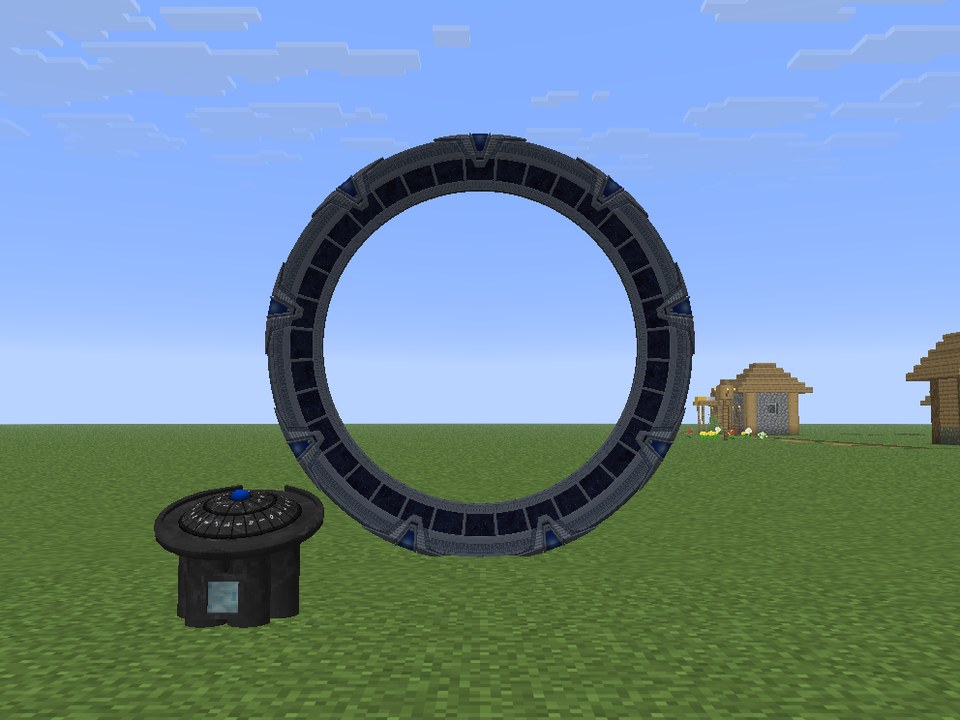
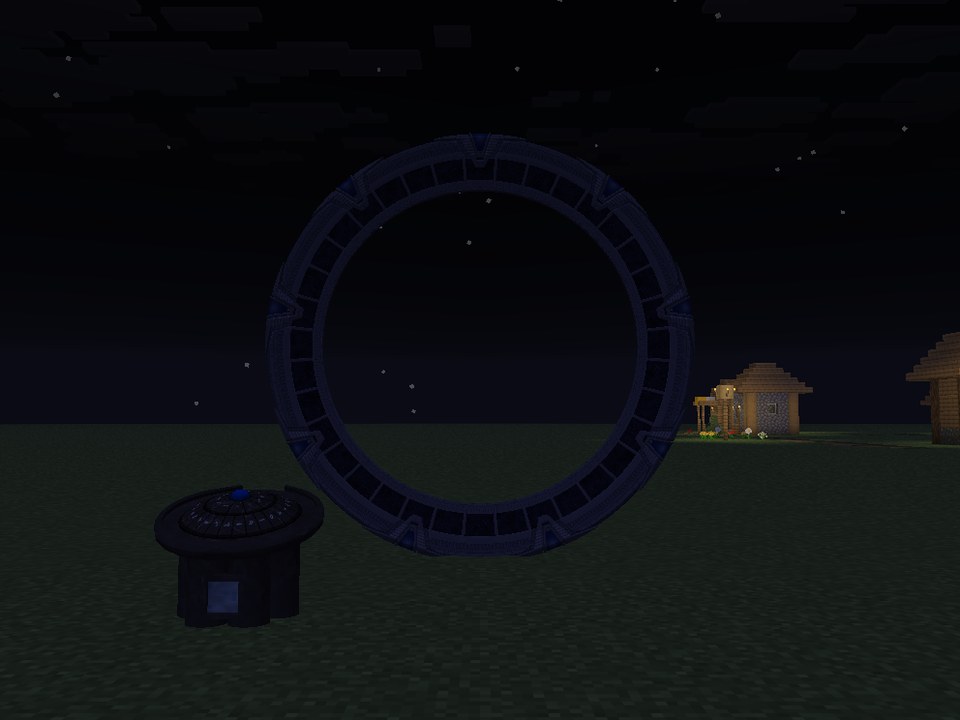
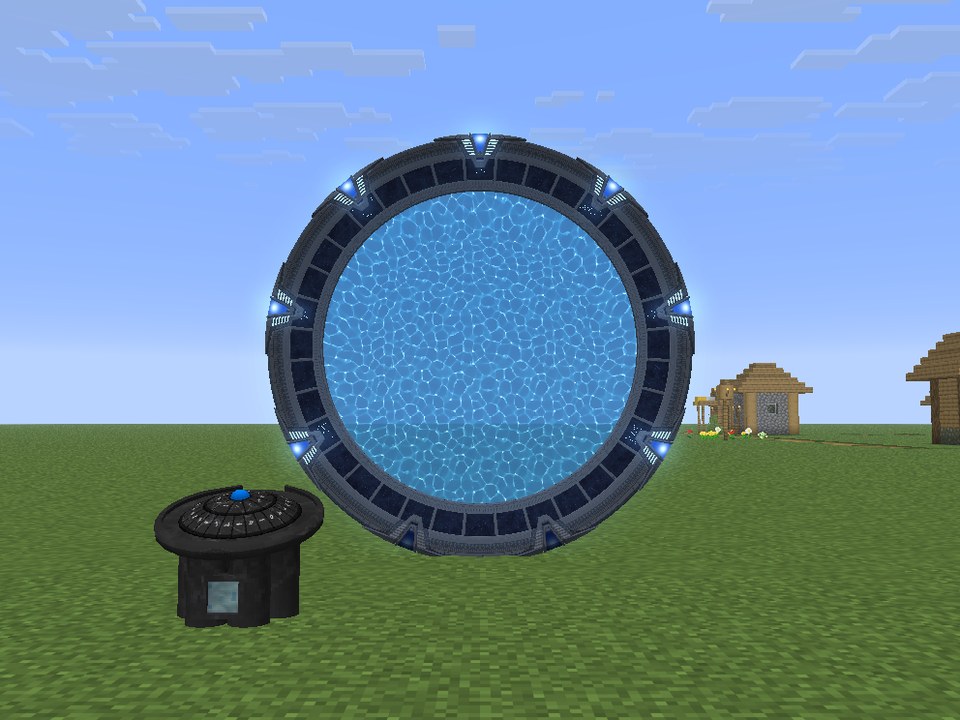
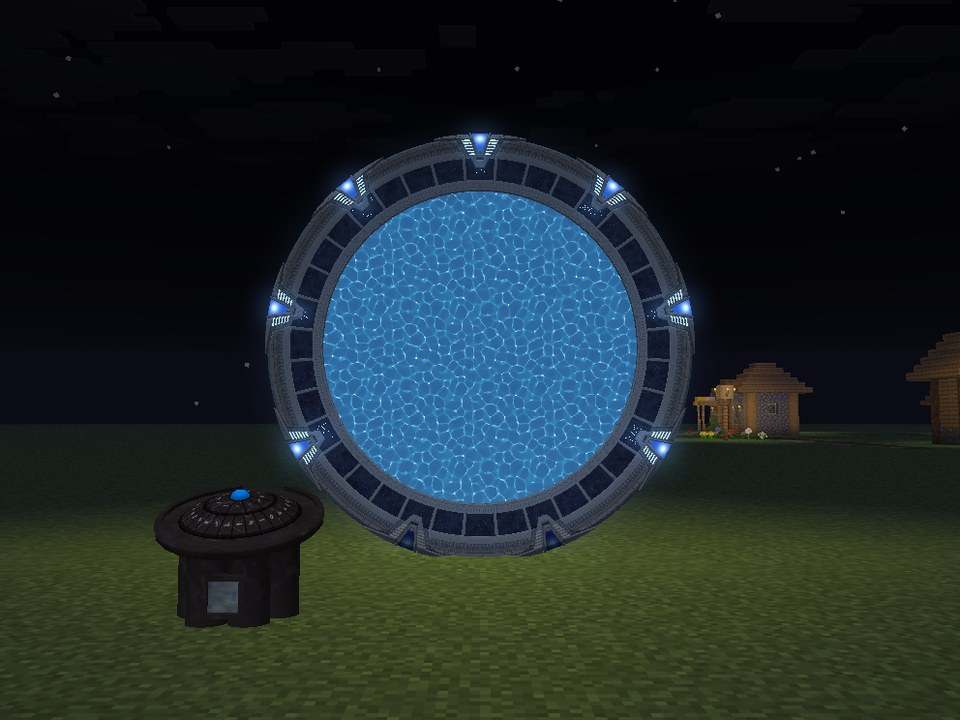
Obtaining
Crafting
You make it from a  Milky Way Stargate Base.


- Glowstone Dust
- Block of Lapis Lazuli
- Redstone Dust
- Milky Way Stargate Base
Generated gates
The world builds a Pegasus gate with this base, and a Pegasus DHD, on the platform near an igloo. Players can't break a generated gate unless its Breakable setting (sgcraft:breakable) is on, or the server setting gates.generated_gates_breakable is on for gates without a setting of their own. See World generation.
Usage
Seen from the front, a standard gate is laid out like this:
C R C R C
R . . . R
C . . . C
R . . . R
C R B R C
B is the base, R a  Stargate Ring Block,
C a  Stargate Chevron Block and
. the opening, which must be air, fluid or event horizon.
- Place the base where the bottom center of the ring goes. It faces you, and the gate faces the same way.
- Build the ring of 8 ring blocks and 7 chevron blocks across its front. The gate forms when you place the last block of the ring, or the base next to a complete ring. If there is no standing ring, the base looks for one lying flat at its own height, running out from the base along its back.
- Place a
 Pegasus DHD less than 6 blocks from the base (
dhd_range, default 6) and no more than 2 blocks above or below it. The DHD dials the gate and holds its fuel.
The player whose block finished the gate owns it. See Building gates for the full build.
Gate type
This base makes Pegasus gates (sgcraft:pegasus). A Pegasus gate's ring stays still as it dials: a light runs around its screens to each chevron. Its ring speed is about 7.14 degrees a tick by default, where a Milky Way gate's is 2 (ring_speed). It shows addresses in the Pegasus glyphs: 


 . The Pegasus gate has no
@ glyph of its own, so it borrows the Milky Way one.
A Pegasus DHD links to it and dials it. A Milky Way DHD doesn't link to a Pegasus gate. A  Personal Dialing Device, a
 Gate Control Tablet and
/sgcraft dial dial it too, and it can dial gates of any type.
Each time a standard gate forms, it takes the type of its base block. To change the type of a formed, idle gate, use an upgrade on it: a  Universe Gate Upgrade makes it a Universe gate, and a
 Pegasus Gate Upgrade makes a gate turned Universe a Pegasus gate again. You need the right to configure the gate, and the upgrade is used up. Operators and creative players can set any type on the
 Stargate Configurator's Gate page, and operators can run
/sgcraft type <type>.
A gate keeps the type an upgrade gave it while its base stays in place, even if the ring breaks apart and forms again. The base block keeps its own kind: a Pegasus base in a gate turned Universe drops a Pegasus base, and the upgrade drops beside it. See Building gates.
The address screen
Right-click the base, or any ring block of the formed gate, to open the Stargate Address screen. The base opens nothing until the gate has formed. Gate tools and upgrades in your hand work on the gate instead of opening the screen.
- The screen shows the gate's address in the glyphs of the gate's type, with the address in letters below.
- Click the panel to copy the address. The client setting
copy_address_on_open(defaultfalse) copies it each time the screen opens. - When the gate's
address_visibleproperty is off, the screen shows "... Gate Address Hidden ...". See Addresses. - A player with the right to configure a standing gate also sees 5 slots labeled Base Camouflage. Each slot takes one block and covers one block of the gate's bottom row, left to right as seen from the front. Any block works except ring blocks, bases and DHDs. A flat gate takes no camouflage. See Building gates.
Address
A gate's address is the address of the cell holding its base. A cell is 8 chunks (128 blocks) across by default. Two gates in one cell share an address and a dial reaches only one of them, so build one gate per cell. A base beyond the address grid, about 2,985,984 blocks out from x 0, z 0, gives its gate no address. See Addresses.
The gate forms with 7 chevrons, which dial gates in the same world. Each  Stargate Chevron Upgrade adds one, up to 9: 8 reach other worlds of the same group, 9 reach other groups. The server's
gates.defaults setting sgcraft:chevrons can give new gates more. See Building gates.
Redstone
The base of a formed gate works with redstone:
- While the gate does anything other than stand idle, the base gives out a full redstone signal of 15, which also powers the blocks it touches. The gate property
redstone_output(defaulttrue) turns this off. - A redstone signal arriving at the base shuts the gate's iris, and the signal going opens it. The gate property
redstone_input(defaulttrue) turns this off. Redstone has every right, so it works whatever the gate's access settings say.
Breaking
Breaking the base, or any block of the gate, breaks the gate apart. A player may break it if they are an operator, if they own the gate and the server setting gates.owners_break_gates is on (the default), or if the gate's Breakable setting is on. Anyone else sees "This gate can't be broken". Explosions and commands still break gates.
When the base breaks, it drops:
- Itself.
- Its camouflage blocks.
- One Stargate Chevron Upgrade for each chevron added with a Chevron Upgrade.
- An
 Stargate Iris Upgrade if the gate's iris was fitted with one.
- The Pegasus Gate Upgrade or Universe Gate Upgrade that set the gate's type, if one did.
Chevrons, irises and types the gate came with, or that an operator, a creative player or a command set, drop nothing.
Breaking a ring block instead leaves the base in place with its type, chevrons and camouflage, and the gate forms again when the ring is whole. Breaking a gate while its wormhole is open sets off a breach explosion, strength 10 by default (breach_explosion). See Building gates.
Commands
Most /sgcraft gate commands act on your selected gate, or else the gate you look at, through its ring or its opening, up to 64 blocks away. Operators can name a gate by any of its blocks with /sgcraft gate <pos> <command>.
| Command | Level | What it does |
|---|---|---|
/sgcraft address | All | The gate's type, position and address |
/sgcraft info | All | The gate's type, position, state, chevrons, owner and connection |
/sgcraft dial <address> | All | Dial an address from the gate |
/sgcraft disconnect | All | Stop dialing, or close the wormhole |
/sgcraft type <type> | Op | Change the gate's type |
/sgcraft chevrons <1-9> | Op | Set how many chevrons the gate has |
/sgcraft camouflage set <slot> <block> | Op | Camouflage one block of the bottom row, slot 0 to 4 |
/sgcraft iris open, /sgcraft iris close | All | Open or close the iris |
/sgcraft owner <player> | All | Hand the gate to another player (owner or op only) |
/sgcraft place sgcraft:pegasus | Op | Build a whole Pegasus gate with 9 chevrons 3 blocks in front of you |
type and chevrons changes need the gate to be idle. See Commands for every command.